
What Is the Real Cost of an Employee in Tunisia?
When a company hires an employee, the net salary paid at the end of the month represents only part of the actual cost borne by the employer.

When a company hires an employee, the net salary paid at the end of the month represents only part of the actual cost borne by the employer. In Tunisia, several social security contributions and taxes are added to the gross salary, often creating a significant gap between what the employee receives and what the company actually spends. ABS’s salary calculator is specifically designed to estimate this difference accurately and provide a complete view of the employer’s cost. [absaudit.tn]
Net Salary, Gross Salary and Employer Cost: What Are the Differences?
To understand the cost of an employee, it is important to distinguish between three concepts:
Net salary is the amount actually paid to the employee after mandatory deductions.
Gross salary is the basis for payroll calculations. It includes the basic salary as well as bonuses and allowances subject to social security contributions.
Employer cost is the total amount borne by the company. It includes not only the gross salary but also employer social security contributions and various statutory contributions.
Therefore, when a company plans to hire an employee at a given net salary, it must take into account all the charges added to the gross salary in order to assess its recruitment budget correctly.
Deductions Borne by the Employee
Before the employee receives their net salary, several deductions are applied to their gross salary.
CNSS Contributions
The employee’s share of CNSS contributions mainly finances the employee’s social protection: retirement, health insurance and other social benefits. This contribution is deducted directly from the gross salary.
IRPP
Personal Income Tax (IRPP) is calculated according to a progressive scale that takes into account, in particular, the employee’s family situation, number of dependent children and certain applicable tax deductions.
Social Solidarity Contribution (CSS)
The CSS is an additional deduction levied in certain situations to help finance public expenditure.
Once these deductions have been made, the result is the net salary payable to the employee.
Employer Contributions: The Often-Overlooked Cost
From the employer’s perspective, the cost of an employee does not stop at the gross salary. Several employer contributions must also be paid.
Employer CNSS Contribution
The employer also contributes to financing the social security system through an employer contribution calculated on the employee’s remuneration.
Vocational Training Tax (TFP)
This tax is intended to finance vocational training initiatives at the national level. Its rate may vary depending on the nature of the company’s activity.
FOPROLOS
The Fund for the Promotion of Housing for Employees (FOPROLOS) is another mandatory contribution borne by the employer.
Occupational Accident Contribution
Its rate depends on the business sector and the level of risk associated with the position. An industrial company will generally not be subject to the same rate as an administrative services company.
Why Does an Increase in Net Salary Lead to a Larger Increase in Gross Salary?
An often-overlooked aspect of payroll calculations in Tunisia is that gross salary does not increase in proportion to net salary. When an employer wishes to grant an employee an increase in net salary, the required increase in gross salary is generally greater than the apparent net increase. This is mainly due to the progressive nature of the personal income tax (IRPP) scale. As taxable income rises, the higher brackets are subject to higher tax rates. Consequently, a growing portion of each additional dinar paid is absorbed by tax and social security deductions. Thus, to provide a net increase of 100 dinars, the employer may have to raise the gross salary by considerably more than 100 dinars, depending on the employee’s remuneration level. The higher the salary, the more pronounced this progressive effect becomes.
This is precisely why a salary calculator is such a useful tool. It makes it possible to measure instantly the actual impact of an increase on the employer’s cost, gross salary and net salary, and to avoid approximations during salary negotiations or when preparing human resources budgets.
Example: an employee whose income already falls within a high tax bracket will retain only a limited portion of each gross increase granted. Conversely, an employee whose income falls within a lower bracket will receive a more favorable net benefit from the same gross increase. This demonstrates the importance of considering net salary, gross salary and total employer cost together.
Illustrative Chart
The following chart illustrates the effect of the progressive income tax scale on payroll cost. As net salary increases, the share of the cost attributable to IRPP, represented by the blue line, rises more rapidly than the share resulting from social security contributions and other taxes. Consequently, the increase in the overall cost, represented by the green curve, is driven more by the rise in IRPP than by the increase in social security contributions and other taxes.
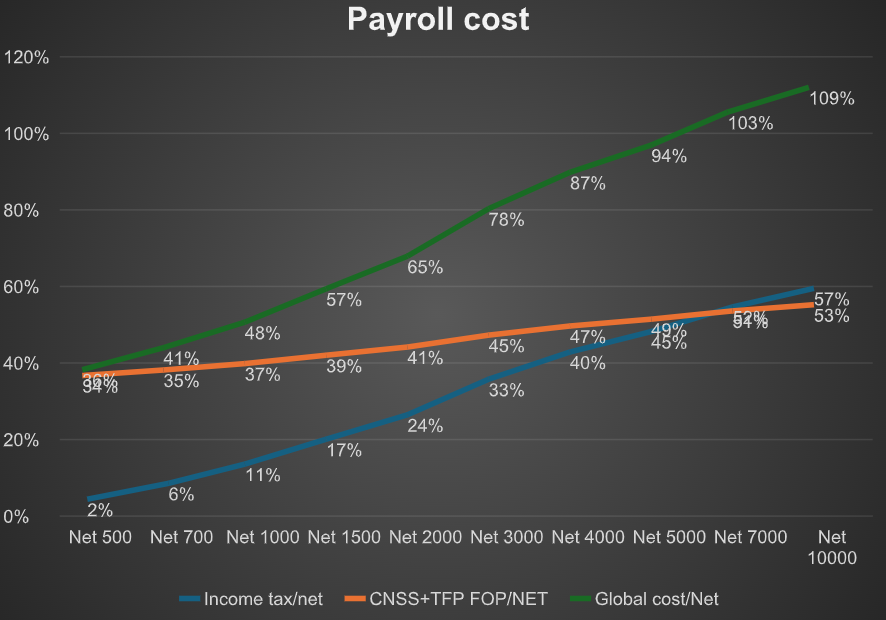
As an example, consider an employee earning a monthly net salary of TND 500 and working for a company with the following characteristics:
- partially exporting;
- non-industrial;
- carrying out an activity subject to an occupational accident contribution rate of 0.5%.
In this situation, the IRPP-related cost represents only 2% of net salary, while social security contributions and other taxes—TFP, FOPROLOS and the occupational accident contribution—represent 34%. Employee and employer charges therefore amount to 36% of net salary. The total cost borne by the employer is therefore TND 680, i.e., TND 500 × 136%.
By comparison, for an employee working in the same company and earning a monthly net salary of TND 10,000, the IRPP-related cost amounts to 57% of net salary, while social security contributions and other taxes represent 53%. Total charges therefore equal approximately 110% of net salary. More precisely, an employer cost of TND 20,928 corresponds to 209.28% of net salary, i.e., TND 10,000 × 209.28% ≃ TND 20,928.
Why Calculate the Total Cost Before Hiring?
A common mistake is to consider only net salary or gross salary. However, recruitment decisions should always be based on the employer’s full cost.
For example, two employees receiving similar remuneration may represent different costs depending on several factors:
- the company’s business sector;
- the applicable occupational accident contribution rate;
- the number of months of remuneration (12 months, 13 months or more);
- the employee’s tax benefits;
- any exemptions available to the company. [absaudit.tn]
An accurate estimate makes it possible to set a realistic budget, prepare cash-flow forecasts and make recruitment decisions more secure.
The Benefits of a Payroll Cost Simulator
Given the complexity of Tunisian social security and tax regulations, companies benefit from using a specialized simulator. The salary calculator developed by ABS Audit can be used to:
- convert a gross salary into a net salary;
- convert a net salary into a gross salary;
- estimate IRPP and CSS;
- calculate employee and employer CNSS contributions;
- determine the total employer cost;
- view how each dinar is distributed among the employee, the State and social security bodies.
This tool is valuable for business leaders, HR managers, accountants and employees seeking a better understanding of their payslip.
Conclusion
The real cost of an employee in Tunisia is considerably higher than the net salary received each month. Between social security contributions, IRPP, CSS and the various employer charges, the difference can be significant. To avoid unpleasant surprises and optimize human resources management, it is essential to have an accurate estimate of the employer’s cost before making any hire.
With ABS Audit’s salary calculator, companies can instantly simulate the full cost of an employee and make recruitment decisions based on reliable, up-to-date information.
Try our Tunisia salary calculator free of charge and discover the real cost of your hires in just a few seconds. lien calculateur VE : https://www.absaudit.tn/en/outils/calculateur-salaire